
How to MC a Conference: Ten Skills Every Professional MC Uses
By Professor John Hale, The Strategy Guy. Updated 10 July 2026.
Small business really is the engine room. 97.3% of Australian businesses are small businesses and together they employ more than five million people.
On Tuesday 26 May 2026, the Queensland Small Business Month Expo returns to the Brisbane Convention and Exhibition Centre, and I will be MC for the day in the Boulevard Auditorium. Free event, around 400 seats, a strong program and an audience of Queensland small business owners who have given up their day to come and learn something useful.
That is the brief I keep coming back to as I prep.
Whatever happens on the day, those owners need to leave better equipped than they arrived.
The Program
It is a serious lineup for a small business audience.
The Reserve Bank of Australia opens the day with the economic outlook. Tom Pagram from Virgin Australia translates AI from a buzzword into something a small business can use on Monday morning. Robert McRuvie from the Brisbane 2032 Organising Committee unpacks where small businesses fit into Olympic and Paralympic supply chains. The Australian Taxation Office closes the day with practical guidance on the tax pitfalls that catch small businesses by surprise.
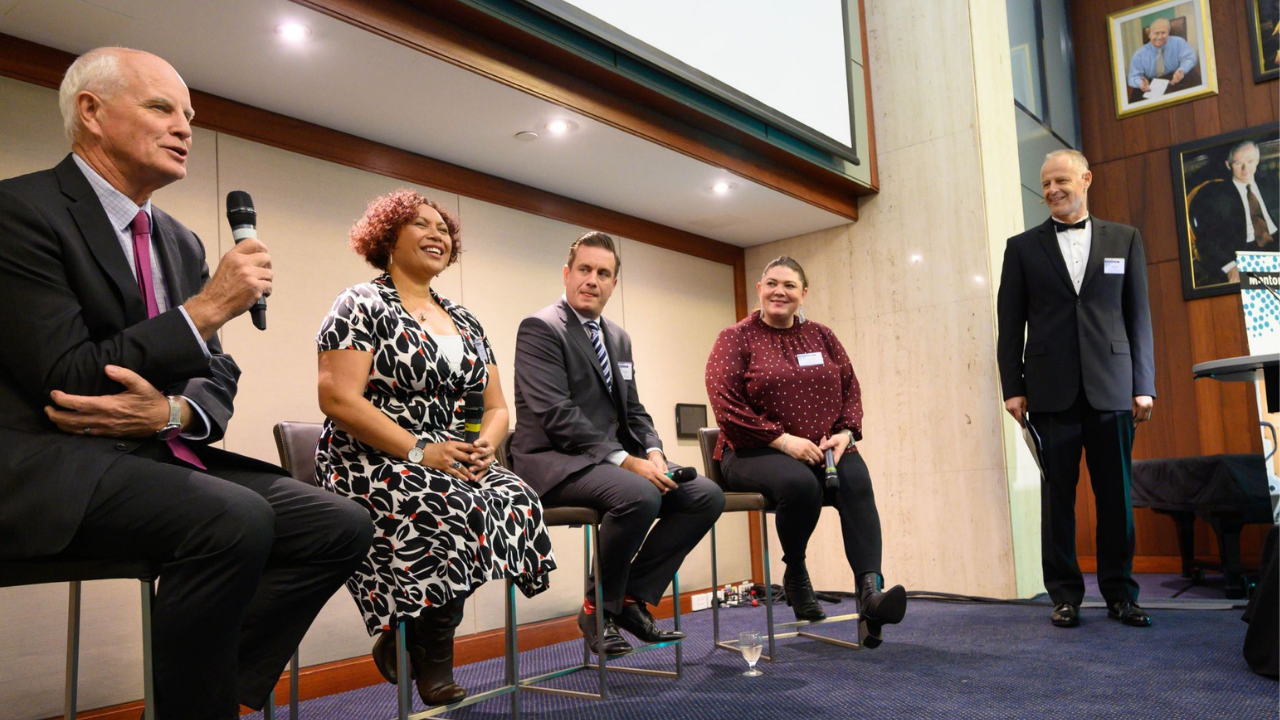
In the middle of the afternoon, I will be facilitating the Resilient by Design panel. Four lenses on one question, which is how do you build a business that is ready for whatever comes next. Cyber Wardens on cyber and scam protection. NAB on cash flow decision making. Korda Mentha on lifting workforce capability without lifting the wage bill. Rosalind Searle from AAMI on insurance. Forty-five minutes, four experts, and a room of owners looking for one thing they can act on this week.
On top of that, the chance to support Queensland Small Business Commissioner Nicolle Kelly and Australian Small and Family Business Ombudsman Lynda McAlary-Smith on the main stage is a privilege. Both offices exist because someone in government finally accepted that small business is the engine room of this economy.
Hats off to Emma Rice and her team at the Department of Customer Services, Open Data and Small and Family Business, and to Nicole Schossow and the Mentoring for Growth crew, for planning this with such care. Three expos in three regions in a fortnight is not a small ask.
Keynote and MC are Opposites
As a keynote speaker, my ideas need to land. The audience leaves with three or four things they can use, and they remember who said them. The job is to be memorable. The brand on stage is mine.
As an MC, the whole thing flips.
It is not about me. It is about the speakers, the sponsors, the audience and the client. The job is to be humble, hold the timing, connect the moments, make everyone else look good, and be almost forgotten by the end of the day. The brand on stage belongs to whoever I am introducing.
Different muscles. Equally valuable. And worth being honest about which one you are using on any given day, because the worst MC moment I have ever seen was a keynote speaker who forgot they were not the keynote speaker.
The sections below are the ten things I keep coming back to. They are not new and most of them are not mine. I have credited the framings I have borrowed where it helps. They are simply the discipline I try to bring to a day like 26 May.
Ten skills for MCs
1. It is your stage, even though the client thinks it is theirs
This framing comes from Warrick Merry, and it is the single most useful sentence I have heard about the role. The client books the venue, sets the agenda and pays the bill. The audience shows up because of the program. But the moment the lights come up and the first speaker walks on; the room is yours to run.
Owning that quietly is what lets everything else work. It does not mean ego. It means responsibility. The energy in the room, the timing, the recovery when something breaks, the pace between sessions. All of that is the MC.
2. Timing is everything, and you cannot rob Peter to pay Paul
The run sheet is sacred. If a speaker runs five minutes long, you do not steal those five minutes from the next speaker. You trim the Q and A, you compress the transition, you cut the personal hook in your introduction and keep the credentials. You never punish the next speaker for the previous speaker's overrun.
Every introduction I write has thirty seconds of trim built into it for exactly this reason. If we are running on time, the audience hears the warm version. If we are running long, they hear the tight one and they do not notice the difference.
3. Vaccinate every speaker before they go on
Another Warrick Merry line, and one of the most quietly powerful things you can do as an MC. Before each speaker walks on, you brief them on the visual cues you will use to bring them home.
-
Hand up at the back of the room means five minutes left.
-
Walking up the side aisle means start to wrap.
-
Coming on stage means one sentence left.
-
Standing next to you at the lectern means finish the word and step off.
Done in advance, this is collaborative. Done in the moment for the first time, it is humiliating. The whole point is that the speaker knows what is coming and trusts you to bring them home cleanly. It also gives you genuine control of the run sheet without ever needing to be aggressive about it.
4. Write your own run sheet before the client sends you one
I build my own version of the day from the public program before the formal brief lands. It takes an hour. It is much easier to edit a run sheet than to write one from scratch under time pressure, and it forces me to think through every transition before I am sitting in the room.
The same applies to introductions. Speaker bios on conference websites are written about the speaker. The introduction in the room needs to be written for the audience. Rewriting it yourself is part of the job, not an extra.
5. The audience is the panel when the panel is not
If the floor goes quiet during Q and A, or if a speaker drops out and you have an unexpected forty-five minutes to fill, the high-value move is not to lecture. It is to turn the audience into the panel.
Take the question from the room. Take the answer from the room. Just facilitate. People's favourite topic is themselves, and whoever has the problem in any room of decent size, somebody else in the same room has solved it. Your job is to connect the two and stay out of the way.
This is also a useful mindset for the formal panel. The best panel conversations are the four panellists reacting to each other, not four serial monologues to the chair. If you are the one talking, you are doing it wrong.
6. Hold the silence
New MCs feel responsible for filling every second. They are not. A two second pause after a speaker finishes is not dead air. It is the audience taking in what they just heard. If you race in with the next intro, you are stepping on the takeaway.
The same applies to Q and A. After you ask the audience for the first question, count to four before you redirect. Most rooms produce a question by three. The MC who fills the silence with their own question kills the chance every time.
7. Inclusive language pulls you onto the team
Never open with ladies and gentlemen. It dates you and it excludes part of the room. Substitute something audience specific and warmer. For a small business audience, I might use small business owners, builders, founders, or simply Queensland's engine room. Pick something that is true of the people in front of you.
The same instinct applies to pronouns. Use us and we, not you and they. The MC is part of the team for the day, not a hired gun standing slightly apart from the audience. Your language is the easiest way to signal which one you are.
8. Add value at every join
The cheap version of MCing is reading the next speaker's name from a card. The valuable version is closing every session with one practical takeaway you heard and re-anchoring the next session's theme before you bring the speaker on.
This is where the role earns its fee. Speakers come and go, but the MC is the only person in the room who hears every session in sequence. Naming the pattern across sessions is the single most useful thing you can do for the audience. They are paying attention to one speaker at a time. You are paying attention to the day.
9. Mistakes are tiny if you handle them quickly
You will mispronounce a name. You will lose a piece of paper. At some point in your career you will fall on a step. None of that matters if you handle it quickly and warmly.
For a botched name, the move is simple. Apologise once, ask the speaker to say it back to you, repeat it correctly, move on. Three sentences and it is over. The audience forgets within a minute. The version that lingers is the MC who pretends nothing happened or, worse, makes a meal of the apology.
Warrick Merry's line for falling on stage is gold. Nobody panic; it is just a stage I am going through. Steal that one, with credit.
10. Be yourself, amplified
The temptation is to put on a voice. Do not. Audiences read inauthenticity in seconds, and an MC who is performing a version of themselves rather than being themselves is exhausting to watch for a full day.
Be yourself. Then turn the dial up a little. If you are warm, be warmer. If you are dry, be drier. If you wear bold colours, wear them. The job is to be a more vivid version of yourself for six hours, not a different person.
This is also where keynote and MC re-converge. Both disciplines reward the version of you that is recognisably you. They just point that energy at different ends of the room.
See you on 26 May
If you run a Queensland small business, this expo is built for you. It is free, it is a full day and the program is genuinely useful. Registrations are open.
Details and registration: https://lnkd.in/gFqBC8PD
Looking forward to it.
#QldSmallBusinessMonth #SmallBusiness #Queensland
Stay connected with monthly newsletter
Recent Posts
Author

John Hale
John Hale, The Strategy Guy, works as a Speaker, Coach, Professor and Author. He teaches in business schools, speaks at conferences, educates start-ups and advises global brands.