
EVOLUTIONARY STRATEGY
The Next Evolutionary Leap won’t be Biological
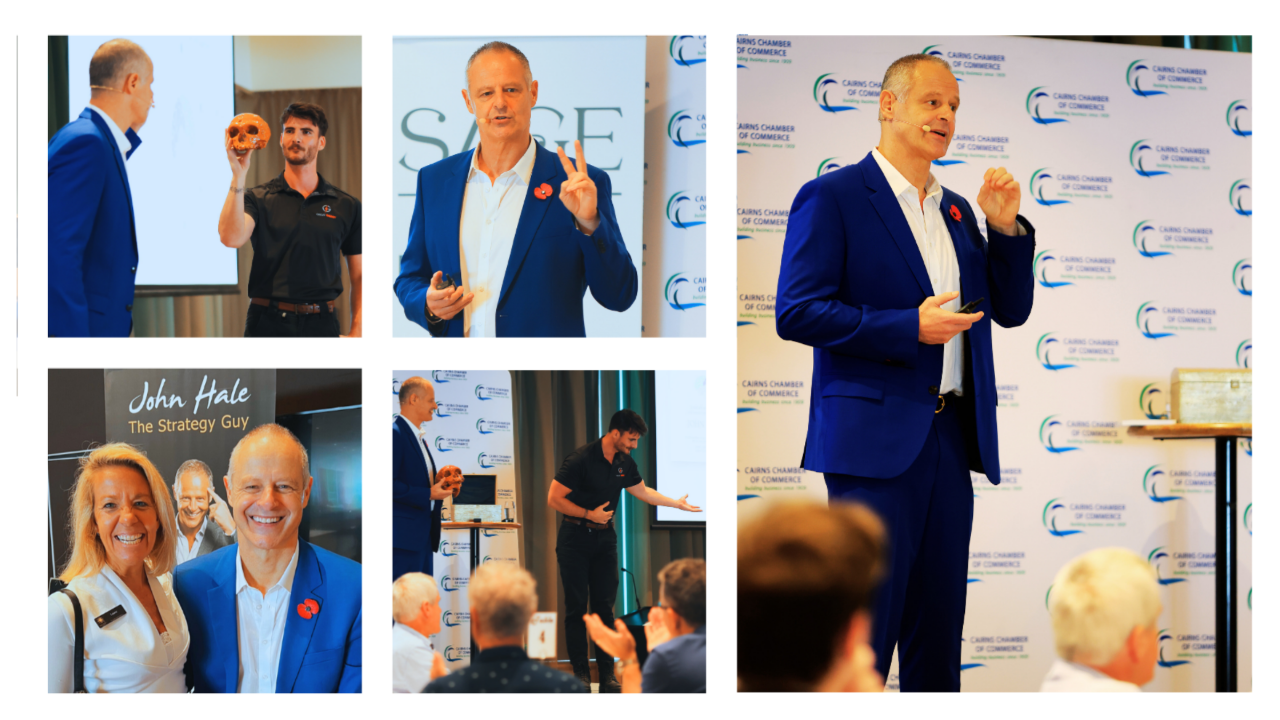
At a recent event at the Pullman Reef Hotel in Cairns, I met Jacob Perrett from Great Energy.
When I asked for a volunteer from an audience of hundred and fifty people, Jacob put his hand up and joined me on stage. Together we explored the difference between the shape of a Neanderthal skull and a modern human skull.
Neanderthals were exceptional at sensing and perceiving their environment. Homo sapiens evolved differently, with a larger frontal cortex that enabled social organisation, collaboration and shared strategy. That difference explains why Neanderthals became extinct and why Homo sapiens dominated.
With modern sensory technologies and the rise of Artificial General Intelligence, these evolutionary patterns are worth paying attention to.
AGI will increasingly perform functions once central to human identity; sensing, predicting, thinking, writing, planning, remembering and creating. Over time, our doubting AI may feel inefficient and wrong. People may experience a reduced sense of authorship, inflated competence without embodied mastery and even anxiety about originality and self-worth. At a global level, those who control the AI models will continue to shape our perceptions of reality. Sadly, like social media, the masses who come to rely on AI uncritically will lose much of their agency.
It was also great to catch up with long-standing Cairns clients and people who have attended my previous talks, including Laurie Pritchard from First World Journeys.
I have had the privilege of sharing strategic conversations with Laurie over recent years and witnessing her resilience through the FNQ tourism downturn triggered by COVID. Wonderful to see her smiling again, back in full swing and her business healthy again.
Stay connected with monthly newsletter
Recent Posts
Author

John Hale
John Hale, The Strategy Guy, works as a Speaker, Coach, Professor and Author. He teaches in business schools, speaks at conferences, educates start-ups and advises global brands.