Some leaders walk into chaos and find clarity. Others walk into the same room and freeze. After 28 years in strategy sessions with some of the world's most senior leaders, I can tell you the difference is not intelligence, experience or resources.
It is three questions. Asked consistently. In the right order. Every time.
I call them the three whats.
Q1. What Is Really Going On?
Most leadership teams think they already know. They do not.
What they know is the story they have told themselves, filtered through bias, blind spots and the sanitised version of reality their organisation has learned to present upward. The most common failure I see is not bad strategy. It is leaders acting decisively on a false picture of reality.
Leaders who outperform build habits that counteract this. They sense their environment deliberately. They ask uncomfortable questions. They create conditions where people feel safe enough to say what is happening, not what the boss wants to hear.
Right now, that environment is shifting faster than most leadership teams have noticed.
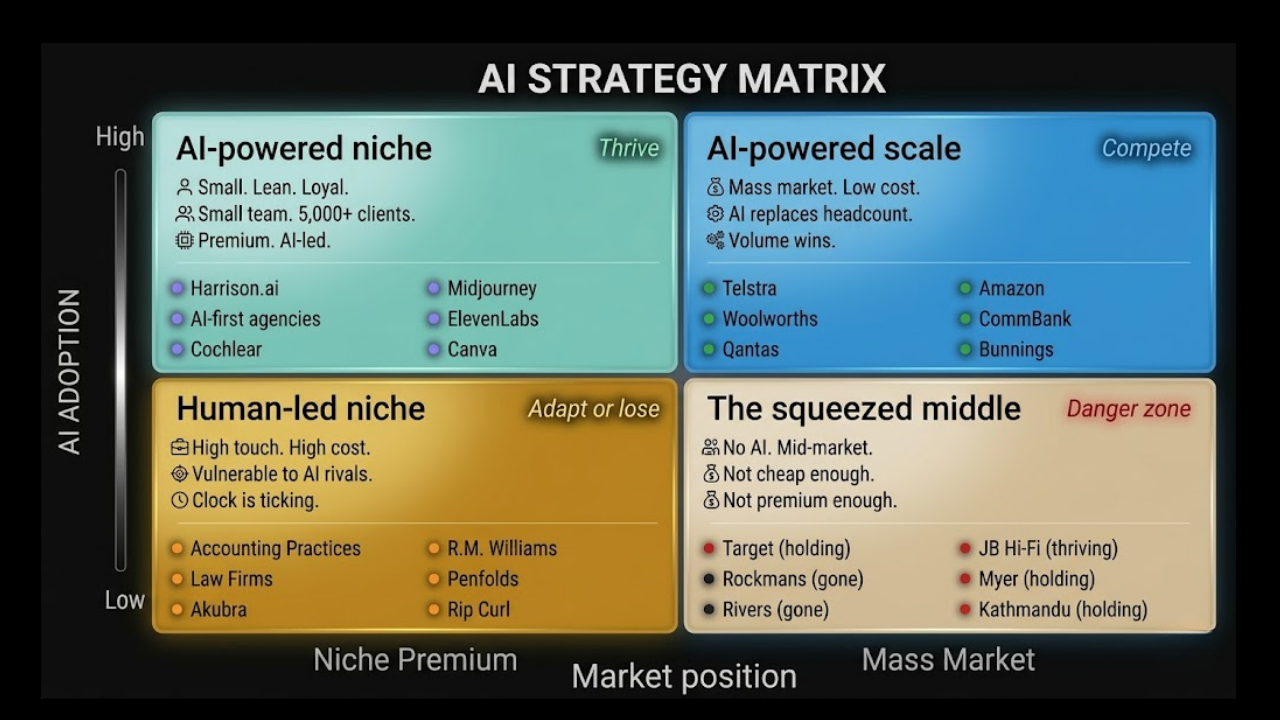
Firms exist because markets are expensive to use. AI is collapsing those costs toward zero, rewriting the logic of the firm entirely. The mass market is dying. Consumers want ultra-cheap at one end and hyper-personalised premium at the other. Mass-market businesses are exposed on both flanks. Niche operators are pulling ahead. The squeezed middle is running out of time.
Inside firms, the same pressure is visible. More than three quarters of knowledge workers are already using their own AI tools at work because company-issued versions feel slow and generic. They are not waiting for IT approval. The environment your strategy must navigate has already changed. Most leadership teams have not yet looked up to see it.
The first question is not a warm-up. It is the whole game. Get the answer wrong and everything that follows is built on sand.
Q2. What Are Our Options?
Most leadership teams present two options to the Board. Option A is what they have always done. Option B is the obvious next move everyone can already see. Neither is a strategy. They are a false binary dressed up as a decision.
One finding from 28 years of strategy consulting is so consistent I now treat it as a law: the quality of your decision is almost entirely determined by the quality of the options you considered before making it.
AI is changing what is possible here. Leaders using technology to sense signals earlier, model scenarios faster and stress-test assumptions more rigorously are building a competitive advantage gap that compounds quietly and then becomes impossible to close.
The second question is never "should we do this?" It is always: "What are all our options, including the ones we have not yet imagined?"
Generating options is the creative act. What comes next is the hard one.
Q3. What Will We Do?
This is where most strategy dies.
The first two questions can be answered in a room. The third must survive the room and live in the organisation for months or years after everyone has gone back to their desks.
A decision that cannot be communicated clearly is not a decision. A strategy that cannot be aligned is not a strategy. A commitment that leadership cannot model in their own behaviour will never be followed by anyone else.
The organisations that navigate genuine crisis most effectively share one thing. Their leaders move from clarity to commitment without hesitation. They know what they have decided. They can say it in one sentence. They build the next 90 days around it and do not look back.
The third question is a commitment, not a conclusion. It is where the thinking ends and the leading begins.
Why These Three, In This Order
The three whats are not new. Leaders have wrestled with versions of them forever.
What is new is the speed at which they must be answered, the noise flooding the information environment and the rate at which a wrong answer now compounds into something irreversible.
My six-step Strategic Mindset Process, developed over three decades and written about in The Strategy Book, gives leaders the tools to answer each of the three questions with rigour: sensing your environment, seeing beyond the next horizon, connecting with the right stakeholders, planning future value, focusing on what truly matters and moving with influence.
In the room, under pressure, with 90 minutes before the next flight, you need three questions.
Q1. What is really going on?
Q2. What are our options?
Q3. What will we do?
The Leaders Who Get This Right
Graham Turner, Chairman and CEO at Flight Centre Travel Group, brought me in for his annual Board and C-suite offsite. The following Monday, his team made a resourcing call they had been avoiding for a while. He told me later the session had not given them new information. It had given them a cleaner way to see what they already knew. That is what the process does. It does not stop working when the day ends.
Pranish Rai from CA ANZ reflected on this after I addressed more than 400 delegates at their National Accounting Online Conference. The process, he said, made strategy genuinely understandable and showed people exactly how to future-proof their firms and careers in a market that no longer rewards the merely competent.
Not another framework to file away. A thinking process that changes how a leadership team shows up when they ask the right questions.
An Invitation
If you are a chair, a C-suite leader or a conference organiser, I would love to talk about bringing Strategic Intelligence for Boards, Strategic Resilience or a custom keynote to your next event. Built for board retreats, leadership conferences and executive offsites.