
What This Summer's Heat Taught Me About Risk, Delay and Who's Really Leading
By Professor John Hale, The Strategy Guy.
This week, as wildfires tore through Ávila, Castellón and Boudreaux ahead of an anticipated 45°C heatwave, Spain's PM Pedro Sánchez said, "we need to agree on a State Pact … to address the increasingly extreme impacts of climate change."
You are a little late to the party, Pedro!
The first official warning came in 1965, that fossil-fuel CO₂ would cause significant climate change within a hundred years. Alas, it took until the 2015 to reach the Paris Agreement, signed by 175 countries, as last-ditch effort to ward off a runaway train that today has well and truly left the tracks.
Drop a frog into boiling water and it leaps straight out; place it in a cool pot and warm it slowly, and it swims on contentedly, adjusting to each new degree until it can no longer jump at all. The pot boils and the frog is dead.
Last month an environment reporter walked on a treadmill for ten minutes at 35°C and 50 per cent humidity. Not a desert. A lab recreation of London in June.
His skin temperature went from 33°C to 36°C in five minutes. His heart rate went from 72 to 95. By the end he was light headed and being helped off the treadmill.
"You're not heat-adapted," the lab director told him. Even relatively healthy people, he explained, can be at risk.
The reporter was Alec Luhn. The room was the heat chamber at the University of Brighton's Environmental Extremes Laboratory. He was not running. He was walking on a slight incline in weather that a great many Londoners lived through in June without a lab technician standing by.
Three things I took from recent research that I did not expect.
1. We're reading the wrong number
Degrees Celsius tells you almost nothing about danger.
Wet bulb globe temperature is heat plus humidity and it is what kills. Sweat only cools you when it can evaporate. Load the air with moisture and evaporation slows. The body's one great cooling system stops working. You can die at 35°C in humid air and survive 50°C in dry air.
This is not an academic distinction. At this year's men's World Cup the Uruguay versus Cape Verde match was played at an estimated wet bulb globe temperature above 33°C. That is the level at which people are advised to suspend all outdoor activity entirely. Not modify it. Suspend it.
It also explains why the deaths this European summer clustered where they did. As New Scientist's editors put it this month: "It is really the combination of heat and humidity that can make activities unbearable." Unbearable is the polite word.
2. The climate bill is already being paid in deaths
A study published at the start of July estimated that June's European heatwave killed around 20,000 people. The 2,700 excess deaths in England and Wales across June were caused by climate change.
Worldwide, heat is now the deadliest form of weather. It kills more than half a million people a year. World Weather Attribution found June days in Europe running 3.5°C hotter than the equivalent days in 1976.
Hugh Montgomery at University College London does not soften it. "This is just the start," he says. "Things are unfolding in a very, very major way now, because this isn't just about it being too hot in London, and the long-term effects are going to be savage."
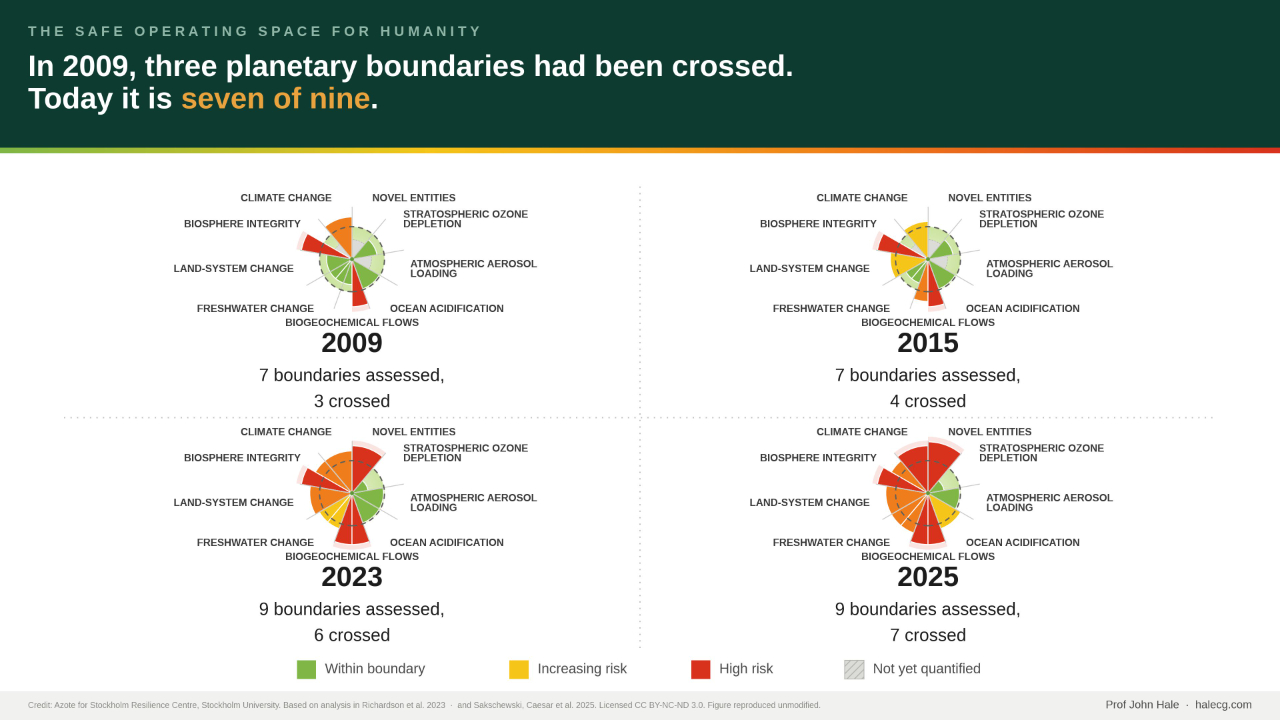
Here is the part that took me a while to absorb. Even if we got to net zero tomorrow the planet would keep warming. Heat deaths would keep climbing on carbon already emitted. Seven of the nine planetary boundaries that kept humanity stable for 12,000 years have already been crossed. The oceanographer Stefan Rahmstorf spent thirty years putting the odds of an Atlantic overturning circulation collapse at around five per cent. He now says "it's more like 50/50." Iceland classified that risk as a national security threat last November.
The shape of the change is not simply hotter. Outside the tropics the window above 32°C has lengthened by twelve days in half a century. The nights have stopped giving relief. Night time temperatures in western Europe are rising at double the rate of global warming overall. A heat stress day followed by a tropical night above 20°C is now 73 per cent more frequent than in the 1970s. Heat spells running two weeks to a month are 3.37 times more common in Europe. It reaches the dinner table too. Heat and drought are already cutting global maize, wheat and soybean yields by around 3.5 per cent at a cost of roughly $20 billion a year. On a high emissions pathway that becomes a 35 per cent yield collapse by 2100.
3. China is doing the work and almost nobody in the US frames it that way
In February the US Environmental Protection Agency finalised the repeal of its greenhouse gas endangerment finding. That was the 2009 determination that greenhouse gases harm human health and it was the legal foundation for every federal climate rule in the country. The World Resources Institute's summary of the repeal is exact: "The science hasn't changed, but the obligation to act on it has been removed."
Consider how that came about. By April 2024 the oil and gas sector had put $7.3 million into Donald Trump's campaign and supporting groups against just $537K to Joe Biden. Biden was the president who returned the United States to the Paris Agreement on his first day in office. That same month at a dinner at Mar-a-Lago with around two dozen energy executives Trump reportedly asked the industry for $1 billion. He described it as a bargain against what he would deliver: lifting the LNG export moratorium on day one, ending Arctic drilling restrictions, opening the Gulf and reversing electric vehicle policy. Congressional committees opened investigations into whether official acts had been offered for sale. Policy has since moved in every one of those four directions.
Meanwhile China kept building.
It now manufactures around 80 per cent of the world's solar modules and roughly 95 per cent of its solar wafers. It produces at least 70 per cent of global lithium battery cells. Of the roughly 580 GW of renewable capacity the world added in 2025 China installed around 450 GW. That is more than everyone else combined. China's CATL alone holds about 40 per cent of the global electric vehicle battery market.
Thanks to China the cheapest solar panel on Earth is a global public good. And it was not made in Texas.
Now there is sodium ion. These are batteries made from salt rather than lithium. Abundant, cheap and free of lithium's energy hungry high carbon processing. They still hold 90 per cent of capacity at minus 40°C. In February Changan demonstrated its new electric vehicle line on an icy track in minus 32°C northern China where a sedan blew a tyre at 95 km/h and coasted safely to a stop. That line now includes the first mass produced electric vehicle with a sodium ion battery. When one of the cells was sawed in half it did not catch fire. It kept powering a light bulb.
"Sodium is the pioneer that can prove that a world beyond lithium is possible," says Maria Crespo-Ribadeneyra of Queen Mary University of London. Elliot Richards is a Shanghai based electric vehicle vlogger who attended the launch. He calls it the "lithium killer" and expects it to make owning an electric car and putting a battery in your house markedly cheaper than the alternatives.
Yes, China is still a big emitter. It is also heating, feeding, cooling and transporting 17 per cent of the world's people. Per head an American emits 13.6 tonnes of carbon dioxide a year against a Chinese citizen's 9.1. And on the measure that actually drives temperature, the accumulated stock of carbon since 1750, the United States owns 24 per cent of the problem and China 15 per cent with four times fewer people to spread it across. The heat killing Europeans this summer was largely paid for by the industrialised West over a century in which China's contribution was negligible.
None of that is a clean bill of health. China's carbon dioxide output rose about 2 per cent in early 2026 and it is still commissioning coal and gas capacity. But there is a pattern worth naming honestly. This is a society that watches what works elsewhere, industrialises it and hands it back to the world at a price the world can afford. It did that with appliances. It did it with safety equipment and with masks. It is now doing it with the technology that decarbonises everybody else.
We are no longer racing to reverse this
We are racing against the severity of it. Every hundredth of a degree by which we slow the acceleration is a harvest that still comes in and a group of people who do not die in a heatwave.
That is a far smaller prize than the one on offer thirty years ago when reversal was still available and we spent the time arguing instead. It is still overwhelmingly worth winning. The difference between the paths in front of us is measured in millions of lives.
Living in the hothouse we've made
So we have to learn a new kind of literacy. The encouraging part is that the body will meet us halfway.
Neil Maxwell runs that Brighton lab and he wants the story told differently. "The narrative at the moment is we've got to get rid of heat; heat is bad, bad, bad," he says. "I think we need to change that narrative to: safe heat can actually be therapeutic." Controlled heat exposure trains your blood vessels to dilate faster. It trains your skin to sweat sooner and more freely. It trains your sweat to carry less salt, which preserves your electrolytes.
The long term data on this is remarkable. In the Finnish Kuopio study of some 2,600 middle aged men those using a sauna four to seven times a week had a 63 per cent lower rate of fatal heart attacks than once a week bathers. They had 40 per cent lower all cause mortality over 20 years and a 63 per cent lower incidence of Alzheimer's disease. A 2020 study of around 30,000 Japanese adults found near daily hot baths cut cardiovascular death risk by more than 25 per cent. The caveat is real. Almost everyone in the Finnish cohort used a sauna so there was effectively no control group, and as Earric Lee of the Montreal Heart Institute puts it, "the jury is still out on this." But the physiology is not in doubt and saunas and steam rooms are the most accessible way most of us will ever get to build genuine heat tolerance.
So, practically:
Understand humidity, not just temperature. 34°C at 30 per cent humidity and 34°C at 70 per cent are different events. Only one of them is trying to kill you.
Watch the overnight lows. If the temperature does not drop below 20°C the body never recovers and consecutive nights compound. This is when damage can be done.
Cool your hands, feet and ears rather than your chest. They are dense with blood vessels close to our skin surface and targeting them drops core temperature far faster. A cool shower beats an icy one, which just makes the vessels constrict.
Train for it deliberately because it is trainable. Aerobic exercise makes the heart better at moving blood to the skin. Regular sauna, steam or hot baths build real tolerance over weeks.
The civic version of the same list: electrify what you can, insulate and shade before you reach for the air conditioning, plant the tree and vote green.
We have already lost the argument about whether this is coming. It is here. It is measured in wet bulb degrees and it is being priced into someone's quarterly results. What remains entirely in our hands is how bad we let it get and how well we look after each other on the way through.
Sources
New Scientist, 18 July 2026. "The heat is on" (leader); "Heat rising dangerously" by Jacklin Kwan and Alec Luhn; "Climate crop losses" by Michael Le Page; "Salt batteries are about to shake up EVs and grid storage" by Alec Luhn; "Heating up" by Alec Luhn; "Heat therapy" by Bill Gifford. Also World Weather Attribution, World Resources Institute, Forbes, Centre for Research on Energy and Clean Air, Yale Environment 360, Our World in Data, IRENA, CnEVPost and Worldometer.
Stay connected with monthly newsletter
Recent Posts
Author

John Hale
John Hale, The Strategy Guy, works as a Speaker, Coach, Professor and Author. He teaches in business schools, speaks at conferences, educates start-ups and advises global brands.